
Make smarter R&D decisions with real-world evidence
Atropos Health helps R&D teams make better-informed development decisions with real-world evidence from the world’s largest medical evidence library and federated healthcare data network. Our platform helps teams evaluate indications, refine trial criteria, assess cohort feasibility, and generate external control arms through advanced analytics and clinical informatics expertise.
precision evidence-based findings in our evidence library
longitudinal patient timelines across the Atropos Evidence™ Network
study and insight output in 10% of the time
peer-reviewed publications, abstracts, and presentations
Strong clinical trial decisions start with strong evidence
Traditional trial design often relies on fragmented datasets, limited patient populations, and lengthy feasibility studies. These limitations lead to restrictive eligibility criteria, recruitment challenges, and costly protocol amendments. R&D teams need a clearer picture of real-world patient populations before committing to a trial design.
Fragmented data creates blind spots
Claims often lack clinical detail, while single-system EHRs provide limited visibility into broader patient populations.
Traditional timelines delay decisions
Lengthy data licensing and consulting engagements can take months, forcing teams to make protocol decisions with incomplete evidence.
Unvalidated criteria limit recruitment
Without real-world feasibility testing, teams risk excluding eligible patients and undermining enrollment targets.
Move from research question to actionable evidence
Define the research question
Your team establishes the research question, target population, comparators, and endpoints using PICO criteria or a protocol synopsis. Our medical informatics and epidemiology teams help refine the study design.
Assess data quality and fitness
Our Real World Fitness Score® evaluates network datasets against your research criteria, identifying sources with the necessary patient populations, variables, and longitudinal detail.
Execute advanced analytics
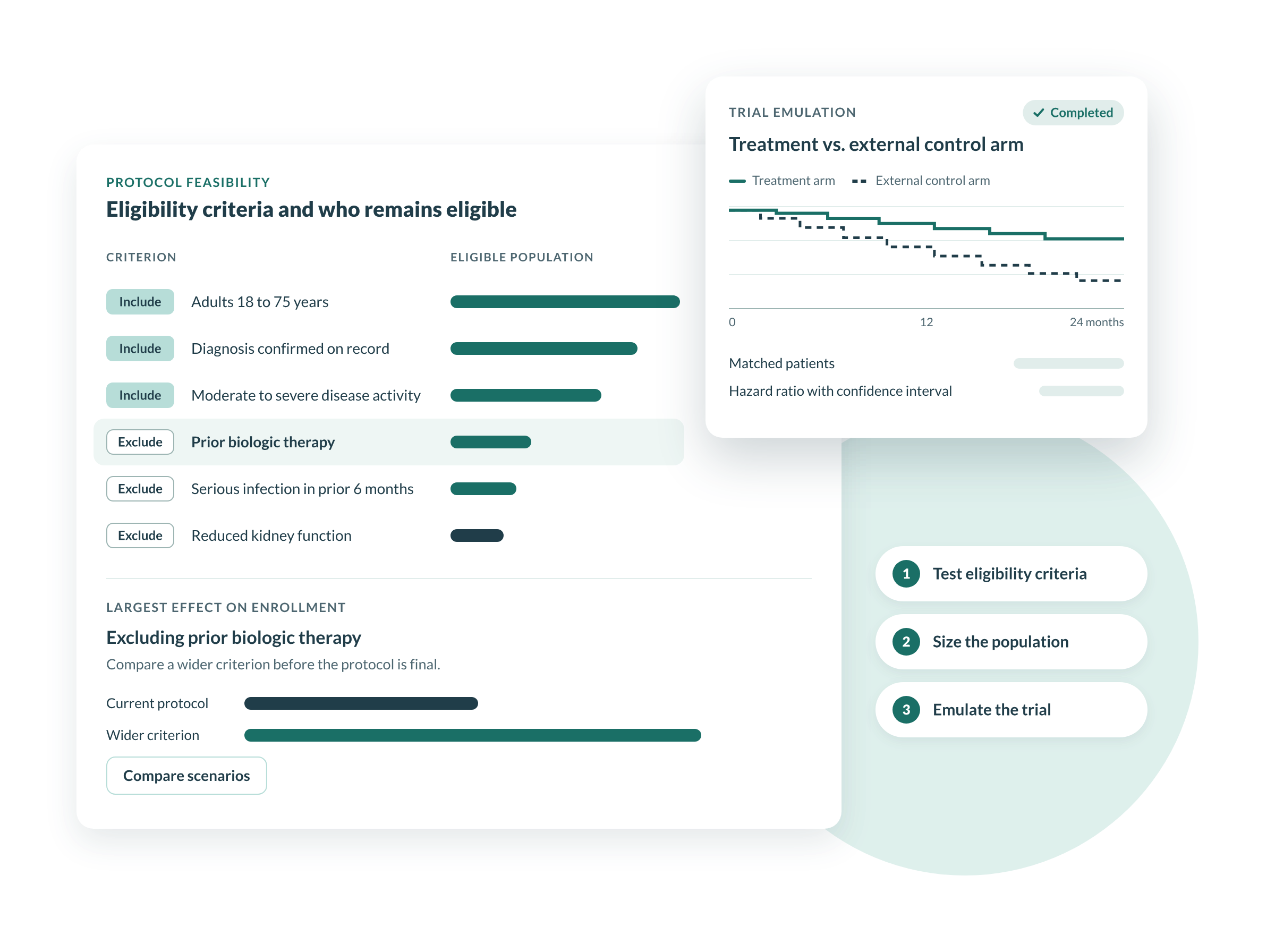
We apply trial emulation, cohort attrition modeling, propensity score matching, inverse probability weighting, and sensitivity analyses. We deliver effect estimates, confidence intervals, and documented methodology.
Refine and iterate
Adjust eligibility criteria, comparators, and follow-up windows, then rerun analyses to evaluate alternative study designs.
Accelerate clinical development from indication prioritization to post-approval label expansion
Scientific governance and control
Your scientists define the research question, patient populations, comparators, and endpoints. Our clinical informatics and epidemiology teams execute the analysis and document each methodological decision, including cohort definitions, covariate selection, matching logic, and executable code.
Publication-ready methods
We apply established epidemiological and biostatistical methods and document our analytical specifications to support transparent, reproducible research.
Federated data security
The Atropos Evidence Network executes analyses within secure host environments, keeping patient-level data within its originating environment and reducing traditional data transfer and licensing requirements.
Flexible engagement models
Choose the tools and expertise that best fit your research needs:
- ChatRWD™: Explore clinical questions through rapid queries.
- Forge™: Run advanced analytics with low-code tools.
- Green Button®: Work directly with clinical experts on complex study design.
We see the importance of real-world data, evidence, and insights to ensure safe and effective use of life-saving treatments. Atropos Health will enable rapid conversion of data into evidence using multiple assets to ensure feasibility and relevance and validate evidence for accuracy and increased confidence.
Featured case studies
Phase 2b Trial Targeting & Clinical Phenotyping
Identifying patients with renal cell carcinoma
Renal cell carcinoma (RCC) lacks a specific ICD-10 code, making it difficult to identify patients through traditional claims-based approaches. Seyltx partnered with Atropos Health to develop a multivariate surrogate diagnostic signature and characterize the patient population for its SILINDA Phase 2b trial.
Atropos analyzed 94.4M records and identified an estimated 5.9M U.S. adults with RCC. The findings helped inform clinical site selection and commercial opportunity assessment.
Key findings
- 94.4M records analyzed
- 5.9M estimated U.S. adults with RCC
- Multivariate surrogate diagnostic signature developed
- Findings informed site selection and market modeling
Quantifying Unmet Need to Inform a Target Product Profile
Characterizing persistent symptoms in gastroparesis
A global biopharmaceutical company partnered with Atropos to evaluate treatment patterns and unmet need among patients with gastroparesis. The team analyzed more than 38,000 patients across the Atropos Evidence Network, examining treatment duration, cohort attrition, and persistent symptoms.
The analysis found that 41% of patients experienced persistent nausea and vomiting, providing real-world evidence to inform target product profile refinement.
Key outcomes
- 38,000+ patients evaluated
- 41% with persistent nausea and vomiting
- Treatment patterns and cohort attrition characterized
- Findings informed target product profile refinement
Bring us the clinical assumption your development program depends on
Submit your target indication, patient population, and clinical timeline using the form below. Our medical informatics team will contact you to evaluate cohort feasibility across the Atropos Evidence Network and identify the right approach for your research question.