
Access relevant patient data without buying a dataset first
The Atropos Evidence™ Network connects de-identified U.S. healthcare data across claims, EHRs, clinical notes, specialty data, imaging, genomics, and registries. Bring us a clinical or research question, see which data sources can answer it, and access the evidence you need without purchasing an entire dataset upfront.
longitudinal patient timelines
clinical specialties
unique conditions and medications
patients represented in clinical notes
The network gives you access based on data fitness
Bring us a clinical or research question. The Atropos Evidence Network identifies eligible data sources, evaluates how well each source fits your needs, and runs the analysis where the data already resides. You see the available data and its fit before a study runs. Access is based on the amount of data your question uses and the complexity of the analysis, rather than a commitment to purchase an entire dataset.
Access what the question needs
Reach multiple data types through one network, without negotiating a separate dataset purchase for every research need.
Understand data fit upfront
Evaluate whether the available population, history, and clinical variables support your question before committing to a study.
Expand as the network grows
As the network expands, additional data sources can become available to support future research questions, subject to applicable access permissions.
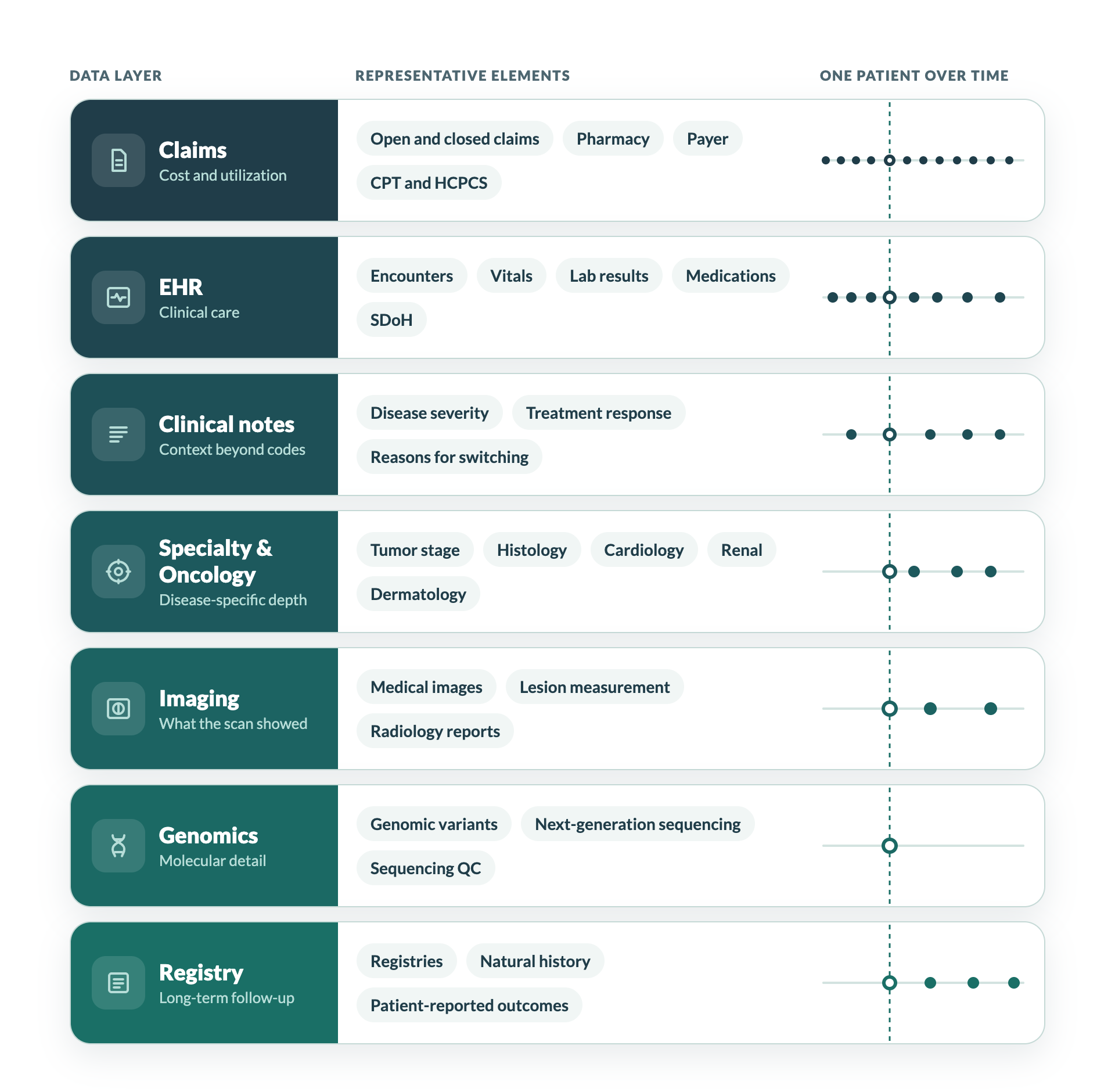
Multiple data types provide a more complete view of patient care
Each data category contributes a different perspective. Together, they help researchers follow patient histories, identify relevant cohorts, and study outcomes across care settings.
Open and closed claims
Includes: Open and closed medical and pharmacy claims, payer and adjudication information, CPT and HCPCS codes
Helps answer: Cost of care, healthcare utilization, treatment patterns, and market dynamics
Electronic health records (EHRs)
Includes: Diagnoses, medications, lab results, vitals, demographics, inpatient and outpatient encounters, ICD-9 and ICD-10 codes, and social determinants of health
Helps answer: Clinical outcomes, comparative effectiveness, treatment history, and safety
Clinical notes
Includes: De-identified, unstructured clinical documentation from patient encounters
Helps answer: Disease severity, treatment response, clinical context, and reasons for treatment changes that structured codes may not capture
Specialty and oncology data
Includes: Disease-specific measures, oncology staging and histology, specialty assessments, and other clinical details
Helps answer: More precise disease characterization, specialty-specific cohorts, and clinical endpoints
Imaging
Includes: Medical imaging and associated clinical information, including radiology findings where available
Helps answer: Imaging-confirmed outcomes, disease progression, and imaging-related research
Genomics
Includes: Genomic variants, sequencing data, and related molecular information where available
Helps answer: Biomarker-defined populations, precision medicine, and genomic research
Registry data
Includes: Disease and procedure registries, natural history cohorts, and patient-reported and quality-of-life measures
Helps answer: Rare disease research, disease progression, and patient-centered outcomes
Mortality information can also be linked across eligible sources to support survival and safety endpoints. Data availability varies by source and research question.The network brings together these categories across participating sources. Individual datasets do not necessarily contain every data type or variable.
Clinical depth across 40+ specialties
Many research questions depend on clinical details that standard claims and diagnosis codes cannot fully capture. Specialty data adds the measurements, assessments, and patient context that help researchers study more complex populations.

Gastro/renal/urology
Renal function, specialized procedures, laboratory measures, and patient-reported outcomes

Cardiometabolic health
Cardiac output, ventricular measurements, arterial function, and relevant clinical measures
Oncology/hematology
Tumor stage, histology, mutation status, tumor size, and grade
Immunology/derm
Lesion measurements, allergy panels, and clinical questionnaires
Neurology/psychology
Clinical assessments, patient-reported outcomes, and quality-of-life measures

Rheumatology
Joint assessments, clinical notes, and patient-reported outcome
Additional areas include rare disease, hepatology, pulmonology, endocrinology, infectious diseases, and more.
Data metrics refresh quarterly. The Atropos Evidence Network integrates newly validated sources continuously to ensure partners always access the most current longitudinal data.
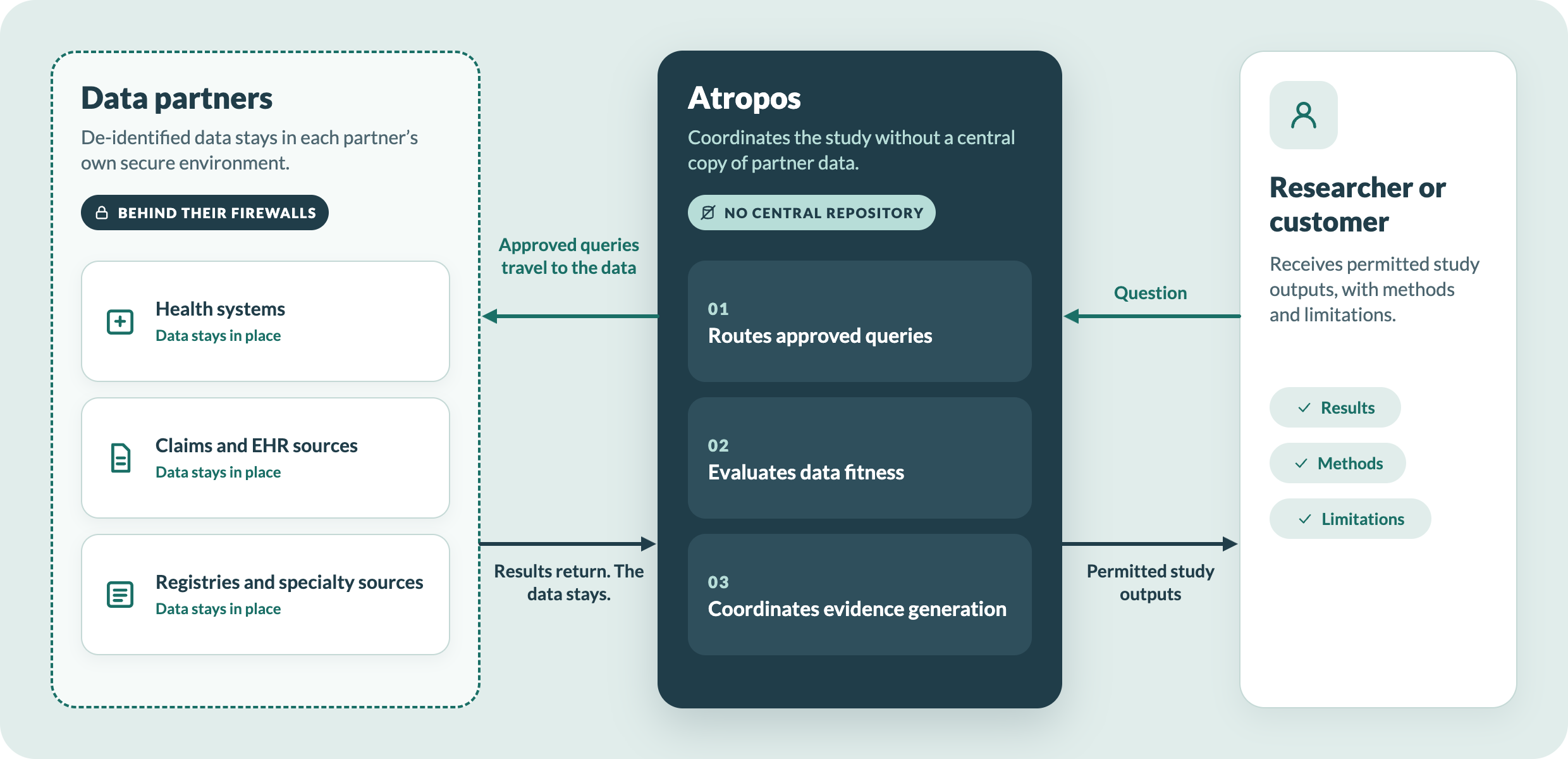
Your question travels to the data, and the data stays in its environment
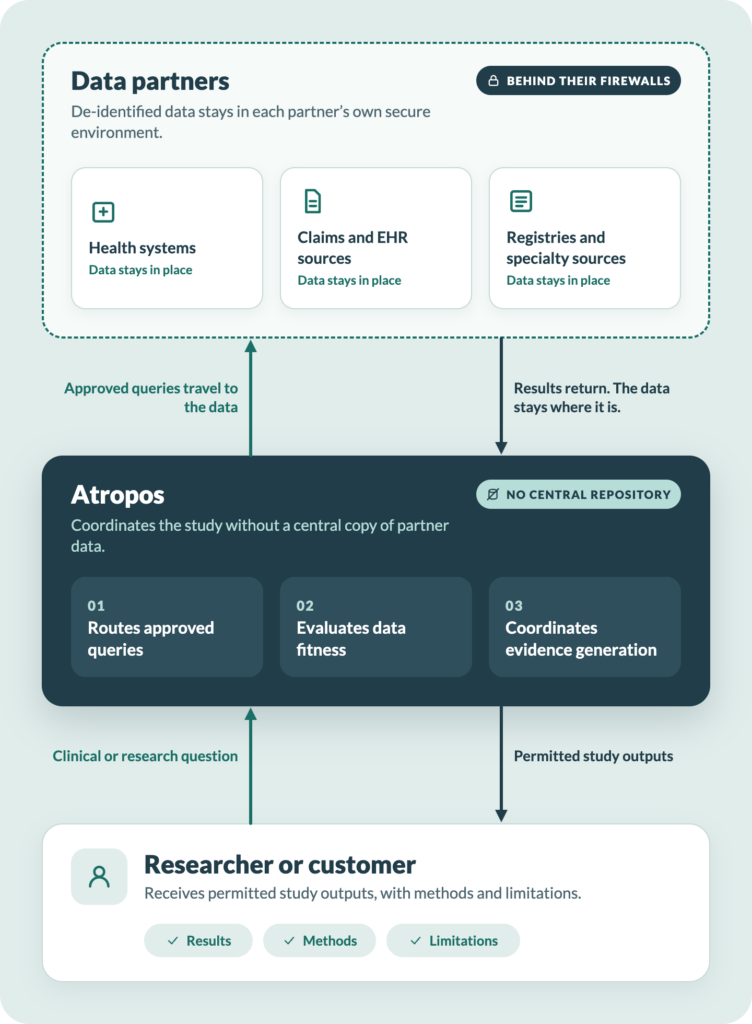
The Atropos Evidence Network uses a federated architecture to connect de-identified data while allowing data partners to retain control of their information. Queries run within each data partner’s secure environment, behind its firewall. The underlying data does not leave that environment. Only permitted study outputs return for review and delivery.
Ask a question
Submit a clinical or research question through ChatRWD®, Green Button®, or the Atropos Evidence Agent.
Evaluate
data fitness
The network assesses eligible sources against the question. Does the source contain the population, clinical history, variables, and outcomes needed?
Run the analysis
Queries execute within the participating data partners’ environments, behind their firewalls. De-identified patient data remains with its owner.
Receive the evidence
Receive study results with the methods, data fitness, and relevant limitations clearly described.
Data quality and fitness
Real World Data Score®
Evaluates the overall quality of a data source, including its size, completeness, and longitudinal depth. Data partners can use this score to understand their data’s strengths and opportunities for improvement.
Real World Fitness Score®
Evaluates how well a data source fits a specific clinical or research question. It helps researchers understand whether the required cohort, variables, and outcomes are represented before a study runs.
One network supports different questions across life sciences, healthcare, and health technology
The Atropos Evidence Network serves as the foundational data layer powering every Atropos product and deliverable. Users query the network via ChatRWD, Green Button clinical consultations, or the Atropos Evidence Agent, and our causal inference engine dynamically routes the question to the optimal datasets to return publication-grade evidence.
Life Sciences
Bring more evidence to decisions across the product lifecycle
HEOR, market access, clinical development, medical affairs, safety, and commercial teams can access data relevant to their questions without sourcing a separate dataset for each project.
Health systems
Study your own patients and compare findings with broader populations
Run approved analyses on your own de-identified data and compare results with eligible network cohorts. The network can help health systems investigate rare conditions, evaluate care pathways, and understand outcomes beyond the limits of their own patient populations.
Healthcare tech and AI
Ground and evaluate clinical AI with real-world patient evidence
Give clinical AI products access to evidence and representative patient cohorts that help teams assess model performance, test outputs, and understand how models perform across different patient populations, including complex and rare cases.
Become a data partner
The Atropos Evidence Network brings together healthcare organizations and data companies that want to make their de-identified data more useful for research and evidence generation.
Control over data use
Your data stays in your environment. You retain control over permitted uses and participation through your partnership agreement.
A clearer view of data quality
The Real World Data Score helps you understand your data’s strengths, completeness, and opportunities for improvement.
Greater visibility into data use
Understand how your data supports approved research questions and evidence generation through partner reporting.
Health systems can also use the network to study their own de-identified patient populations and compare findings with broader cohorts.
With the Data Quality ScoreCard, we could easily identify the strengths and weaknesses of our existing data. We clearly understand how to invest to improve it further, and how to highlight our strengths versus benchmarks for the key use cases we serve.
By combining Scipher’s unique RA data assets with Atropos Health’s cutting-edge AI evidence generation tools, like ChatRWD, we can provide clinicians with powerful tools to make more informed treatment decisions and deliver personalized care.
Bring us a question and see what the network can answer
Start with a clinical or research question. We’ll help you understand which data sources fit, what evidence the network can generate, and how to move forward.